
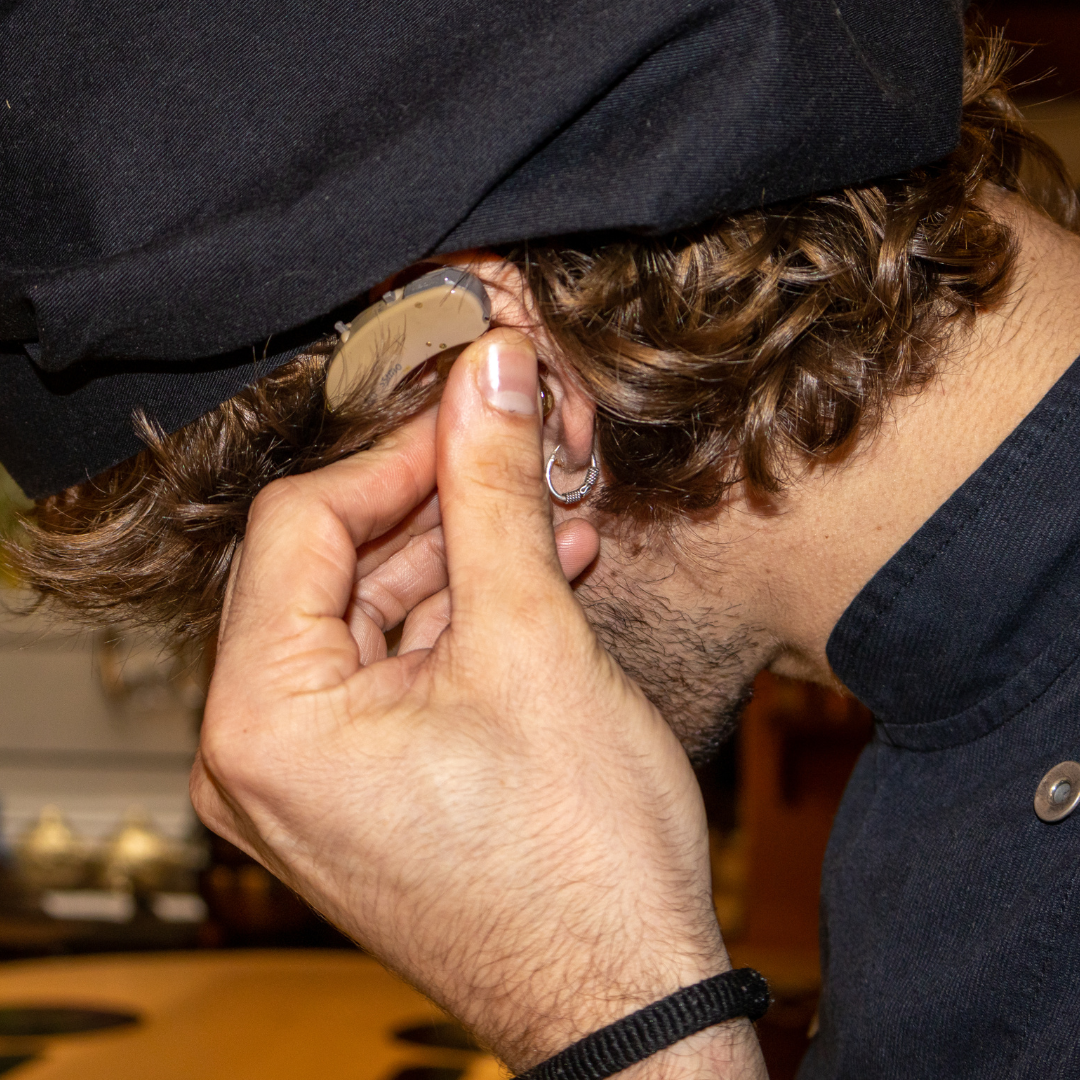
Following dinner conversations becomes challenging when high ambient noise interferes with your focus and hearing. Our practice can evaluate hearing in both quiet and noisy conditions to identify what makes these environments difficult. When we isolate the root mechanism behind your difficult hearing, we guide you toward customized communication solutions.
How Can Hearing Seem Normal at Home but Fail in a Restaurant?
Calm domestic settings establish a positive signal-to-noise ratio, allowing target speech to stand out clearly from faint background noises. Dining rooms present an unfavorable acoustic reversal of this dynamic. Overlapping chatter, piped music, kitchen clatter, and hard-surface reverberation mask speech, forcing the brain to expend immense cognitive effort to track conversation.
This problem can occur with high-frequency hearing loss, auditory-processing difficulty, or age- and noise-related changes. Factors including listening fatigue, poor dining lighting, acoustic distance, and wandering attention make comprehension significantly harder. Numerous individuals show standard hearing thresholds on paper but reveal marked comprehension drops on clinical speech-in-noise testing. Communication breakdowns in loud restaurants should be professionally assessed even if one-on-one listening feels uncompromised.
How Audiologists Identify High-Frequency Hearing Loss
We begin by reviewing your history of communication difficulties, prior noise exposures, ringing or tinnitus, pharmaceuticals, and unilateral symptoms.
Pure-tone audiometric evaluations measure the absolute quietest sounds audible across specific octave frequencies using air and bone conduction. Patients with high-frequency hearing loss typically exhibit a sloping audiogram configuration where sensitivity steadily declines at elevated pitches. Further clinical diagnostics feature tympanometry to evaluate eardrum and middle-ear mechanics as well as word-recognition testing for speech comprehension.
Since sound-treated booths cannot replicate the chaos of a crowded dining room, speech-in-noise testing provides critical real-world insight. This procedure gauges speech-discrimination accuracy while competing multi-source noise becomes incrementally louder. Collectively, these evaluations clarify if your challenges relate to raw audibility, phonetic clarity, signal-to-noise processing, or compound factors.
How Auditory Processing Difficulties Impact Adult Hearing
A diagnosed auditory processing disorder affects how the brain’s auditory cortex analyzes, organizes, and interprets sound. The physical ear mechanisms may capture tones correctly, but the central brain pathways struggle to filter competing inputs, parse similar consonants, or interpret rapid speech. Our clinical team starts by examining peripheral auditory thresholds, subsequently deciding if an auditory-processing test battery or multidisciplinary consultation is necessary.
Behavioral Strategies for Hearing Clearly in Loud Venues
Small, intentional adaptations can optimize the clarity of speech reaching your ears and leverage helpful visual speech cues. Before leaving home, identify quieter dining venues or plan to eat during less crowded service times. Facilities equipped with upholstered booths, acoustic baffles, fabric curtains, carpeted floors, and soft materials prove far easier on hearing than minimalist, hard-tiled spaces.
Practical seating strategies in the dining room:
- Ask for seating positioned far away from open kitchens, noisy bar areas, ceiling speakers, and large parties.
- Position your chair against a perimeter wall to diminish competing auditory chatter behind your head.
- Position yourself to directly face companions under bright lighting to enhance facial comprehension.
- Reduce physical spacing between yourself and companions to maximize direct speech perception.
- Angle your stronger-hearing ear toward the primary individual you wish to converse with.
- Request that companions rephrase misunderstandings using different words rather than repeating the same sentence.
- Explicitly repeat back important logistical details instead of pretending you caught every word.
- Step away for a brief auditory rest when cognitive listening fatigue begins to set in.
- Encourage friends to enunciate clearly while maintaining an even, normal conversational tempo.
- Raised or shouting voices warp acoustic phonetics and rarely improve speech intelligibility.
The Best Hearing Devices for Overcoming Restaurant Noise
Selecting the ideal assistive technology depends upon underlying diagnosis, specific acoustic challenges, and verified hearing loss. Advanced hearing aids utilize beamforming directional microphones, adaptive noise reduction, and specialized restaurant programs to elevate voices directly ahead while suppressing ambient chatter. Patients must uphold realistic expectations because modern amplification cannot strip out every ambient human voice completely.
Utilizing an external remote microphone can deliver a dramatically superior signal-to-noise ratio. The microphone is placed near or worn by the speaker and sends that voice directly to compatible hearing aids or another receiver. This targeted setup effectively neutralizes the negative impacts of room distance and interfering background noise.
Other useful options include:
- Dedicated table microphones engineered to capture small-group dialogue
- Telecoil sensors configured to access hearing-loop broadcasts in looped facilities
- Mobile device live-captioning programs and speech-to-text transcription software
- Consumer wireless earbuds or hearables featuring customizable assistive listening modes
- Sound-meter apps and acoustic dining directories for locating quiet venues
We will help compare available technology, verify device compatibility, and instruct you on utilizing your selected hearing equipment.
The Clinical Role of Audiologists in Managing Loud Environments
A thorough audiological evaluation expands the diagnostic scope well past simple quiet listening performance. We examine the challenging acoustic venues, conversational setups, and noise profiles you encounter to select appropriate diagnostic tests. Your diagnostic appointment may incorporate pure-tone air and bone thresholds, acoustic middle-ear testing, word-recognition scores, and speech-in-noise measures. Specialized auditory-processing testing can be ordered when patient history and preliminary audiometric findings warrant deeper neural investigation.
Any sudden, asymmetric, or rapidly deteriorating hearing loss demands immediate medical evaluation by an ear, nose, and throat physician. Comprehensive clinical care targets the physiological roots of hearing difficulties rather than simply writing them off as bad restaurant acoustics.
Book Your Comprehensive Hearing Evaluation Now
If dining in loud spaces leaves you feeling isolated, fatigued, or guessing at missed speech, contact us to schedule a thorough hearing evaluation. Our clinical team will determine the best strategies to improve your hearing in noisy environments through custom hearing-aid programming, remote microphones, or targeted auditory rehabilitation.
Contact our audiology office today to schedule your evaluation and move toward effortless, confident conversations.